- Full 3D treatment plan before you start
- Remote monitoring — fewer flights
- Retainers included
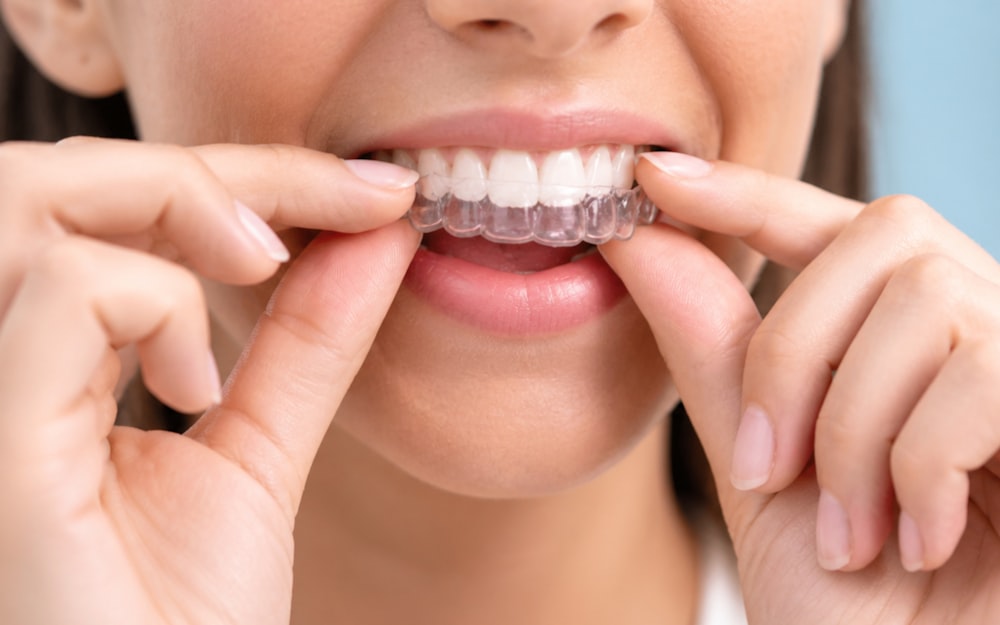
Clear aligners are a series of removable transparent trays. Each one moves your teeth a fraction of a millimetre; you change to the next every one to two weeks until the sequence is complete.
The question worth asking before veneers
If your teeth are crooked but healthy, aligners move them. Veneers disguise them by removing enamel and building a straighter shape on top. Both can produce a straight-looking smile; only one keeps your teeth intact.
Aligners take longer and cost less. Veneers are faster and change colour at the same time. There are real reasons to choose either, but the choice should be made knowing that one is reversible and the other is not. A clinic that jumps straight to veneers for a crowding problem has skipped a conversation you were entitled to.
What aligners treat well
- Mild to moderate crowding
- Spacing and gaps
- Relapse after childhood braces — one of the most common adult cases
- Mild bite issues where the jaw relationship itself is sound
Where fixed braces are still better
Severe crowding, significant bite discrepancies, teeth needing large rotations, and cases requiring extractions are handled more predictably with fixed appliances. We will tell you when that is the honest answer, even though it is not the treatment you came asking about.
Timeline and travel
| Stage | What happens | Where |
|---|---|---|
| Records and plan | 3D scan, treatment simulation | İzmir, 1–2 days |
| Wearing the trays | 6–18 months, changed at home | Wherever you live |
| Monitoring | Photos sent remotely; in-person only if needed | Remote |
| Retention | Retainer, worn nightly, indefinitely | At home |
This is the one treatment on this site that mostly happens away from the clinic, which makes it well suited to patients who cannot travel repeatedly.
Cost
Prices change with our current offers, so message us for an up-to-date quote. It covers the full course, including the trays and the planning. Cost scales with how many trays the movement requires, not with how long you wear them.
The part people underestimate
Aligners only work while they are in your mouth — 20 to 22 hours a day. They are removable, and that is both their advantage and the main reason treatments run long. And retention is not optional: teeth drift back for years afterwards. A retainer worn at night, indefinitely, is part of the treatment, not an afterthought.
Common questions
Are aligners really invisible?
They are transparent and most people do not notice them in conversation, but they are not literally invisible — someone looking closely will see the edge. Attachments, the small tooth-coloured bumps bonded to some teeth to grip the tray, are also faintly visible.
Can I eat with them in?
No. They come out for every meal and for anything other than water, then go back in immediately. That discipline is what keeps you at the 20–22 hours a day the plan assumes.
How is this monitored if I live abroad?
Photographs at set intervals, reviewed against the plan. Most courses need no in-person visit between the start and the finish; if something is not tracking, we adjust remotely or bring you back for a single appointment.
Aligners or veneers for crooked teeth?
If the teeth are healthy, aligners — because nothing is removed. Veneers make sense when you also want to change colour or shape, or when the misalignment is too small to justify months of treatment. Many cases are best served by aligners first and minimal bonding afterwards.
Will my teeth move back afterwards?
They will try to, for years. This is true of every orthodontic treatment, fixed or removable. A nightly retainer prevents it and is the difference between a result that holds and one that quietly undoes itself over five years.
Not sure if this is right for you?
Send us a photo. We will tell you honestly what you need — and what you do not.